Note: The article in the duplicate is present on the author’s other social media accounts as well.
In this article, we shall cover the steps to perform un-supervised query expansion and how to use it to re-rank documents in the task of Information Retrieval. Most of the points are taken from the research paper by Zhuang and Cucerzan ([1]).
Some key points in this paper Zhuang and Cucerzan ([1] )by here:
-Semantic query context can be extracted from query logs.
-The aim is to improve the document retrieval results.
-PageRank performs accumulated rank computations on the entire set of documents/web as the case be. It does not depend on query terms much to decide the ranking of documents.
-The algorithm of HITS utilizes query processing for ranking of documents or web pages.
-What is Query Expansion? There are times when the query presented by the user to a search engine is inadequate is a misnomer or is unambiguous. This happens quite frequently if the search engine does not utilize modern ways to append the query using Query Expansion.
-Query expansion adds useful content to the proposed query by the user based on certain characteristics, such as log books, search engine query logs, or many times as per the liking of other people with similar interests, such a process is called collaborative filtering.
-In the paper Zhuang and Cucerzan ([1]) the authors suggest the use of query logs for improving search results.
-In Zhuang and Cucerzan ([1]) authors proposed Q-Rank a method to refine search results.
-Most commonly used query extensions from search logs of a query are analyzed and collected.
-Next, consider a set of queries that are adjacent to a query in user search sessions. There are two types of such queries, one that precedes the query and one that follows such a query. The authors however restricted the use of queries that preceded the query for obvious reasons of predictability.
-The authors also devised a term called Q_extension where the prefix of the query is eliminated from the queries in the query logs of the search engine query log.
-Let rank(doc_i, query q) be the rank of document i as per some document ranking technique.
-The authors tried to improve the query ranking of the documents using the following formula (note this formula is modified by the author of this article, to attain simplicity.
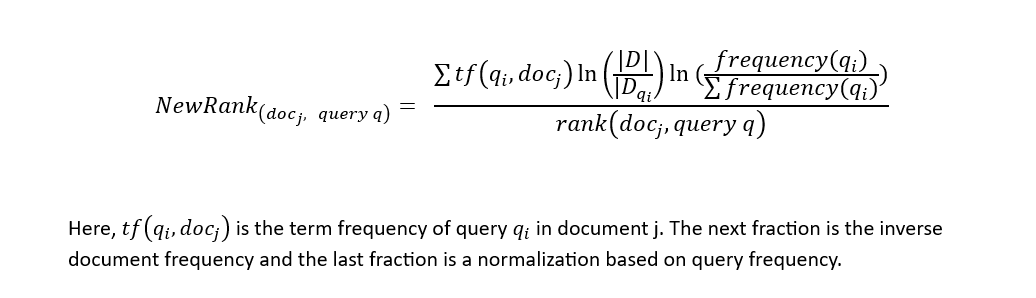
-The original formula can be looked up in the paper Zhuang and Cucerzan ([1]). This is the first relevant half of the formula presented here. The new ranks generated here are divided by the original ranks.
-The authors Zhuang and Cucerzan ([1]) reported improvements in with their techniques.
-This article presents a simple formula as the first half of the formula seems more dominant and hence is presented here. This does not rule out the importance of the original.
References
[1] Zhuang, Z., & Cucerzan, S. (2008, August). Exploiting semantic query context to improve search ranking. In 2008 IEEE International Conference on Semantic Computing (pp. 50–57). IEEE.
 Artificial Intelligence, Computer Science & Mathematics