A “what if” alternate. What if there were no AI?
What would life have been like?
What would professions be like then?
What would gadgets be like?
What would science be like?
What would culture be like?
Let’s explore what the world might look like today if there had been no AI — meaning no explosion of machine learning, generative models, or automation breakthroughs since AI was around.
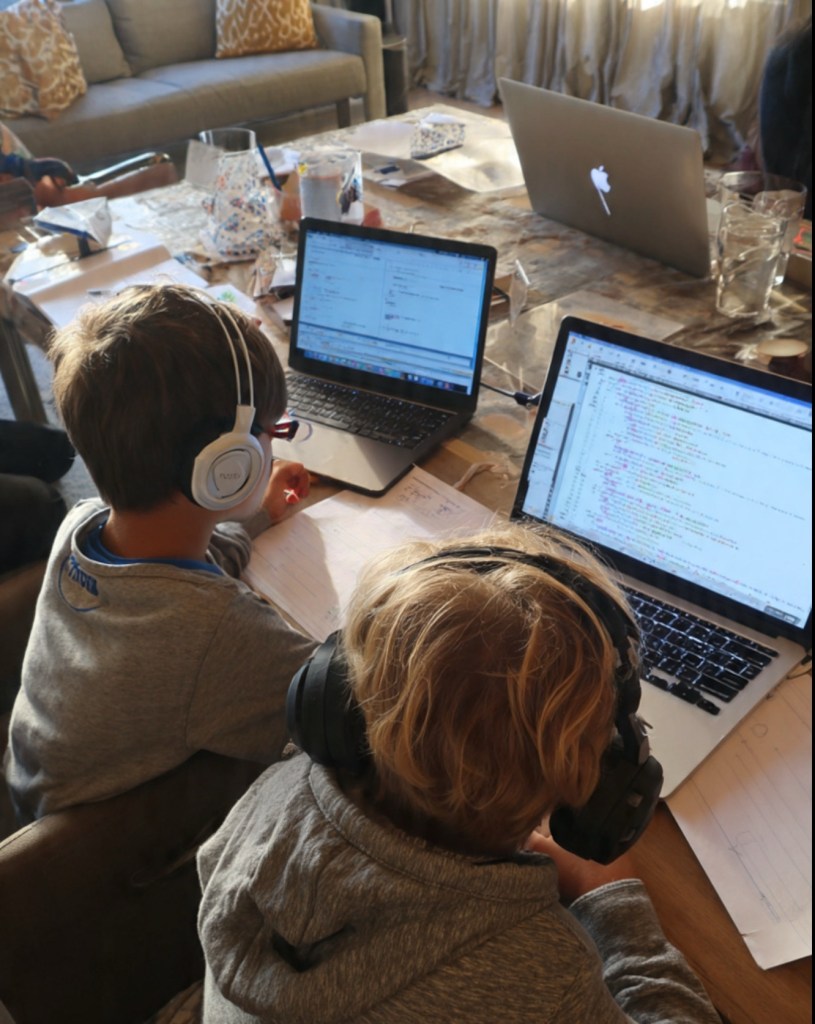
Here are children learning coding in pre-AI boom era rather than learning Quantum in age without AI, and no AI tech savvy tutors. Can we spare children for cricket grounds and tell parents that all would be fine. Let children do children things.
1. Technology and Economy
Slower innovation pace:
Many sectors, such as software, biotech, robotics, and fintech, would have been slower. Chatbots, recommendation engines, and autonomous systems would have been primitive. Many software programs would have matured to their maximum potential, leading to layoffs in the software industry, as the software had already reached its peak development. With code refactoring and bug fixes complete, the next step is to maturely release software products to new customers, if applicable. For services based softwares, maintaining a close relationship with application engineers with some front end and backend engineers is what would be left. Biotech would have been similar to software managed by humans. Robotics would have been without AI; anyone could tell what that means. Robotics is also part of AI, so let’s see that there won’t be many automation tools. Therefore, jobs in warehouses for manual work would have continued.
No trillion-dollar AI race:
Companies like OpenAI, Anthropic, and DeepMind wouldn’t exist in their current form. Big Tech (Google, Microsoft, Amazon) would likely focus more on traditional computing, cloud infrastructure, and data analytics rather than AI integration. Again, mature software may have led to layoffs. Now there is hope that we are building better products. One thing AI may have given us is hope that we have reached the end of the cliff, but there is still a way out.
Startups:
The startup ecosystem would still be driven by apps and platforms, similar to the early 2010s (think Uber, Airbnb, Instagram) — not AI-driven services, but rather basic services like commuting. Saturation would have reached here as well. People would have thought, What’s next? And AI would have come to their minds. Believe it or not, next-gen researchers would have been thinking of AI; it’s a human tendency.
2. Work and Employment
- Less automation:
Human labor would remain central in customer support, design, content creation, translation, and coding. Young children would apply for coding jobs right after their twelth grade, so why not in other sectors? - Job security vs. efficiency:
There might be more jobs in blue-collar industries. Jobs like analytics and statistics would still be performed manually. Overall productivity would be lower, as saturation would have overshadowed it. People would realize they have reached the end of the cliff. What next sounds good to everyone’s mouth? - Education & creativity:
Students wouldn’t have instant tutors, idea generators, or essay helpers. Creative industries would rely more on manual effort — fewer “AI artists” or automated video tools. Faculty saturation would occur with more faculty members but the same workload, increasing the burden on faculty. Students would learn graduation subjects in school to make a difference, such as Quantum for school children. More PhDs would be coming to universities, challenging older faculty, and potentially leading to unemployment, as many subjects would be taught in schools. This may have reduced the student-teacher ratio. Between 2015 and 2018, until a real AI breakthrough occurred, there was a trend of teaching students coding, which would have filled many graduate jobs with applications from school passouts possessing excellent coding skills.
3.Information and Media
- Less misinformation—but fewer breakthroughs:
Without AI-generated content, deepfakes, and synthetic news, there wouldn’t have been terms such as misinformation. However, the impact would have been on translation products, real-time captions, and summarization technologies. People would have found other ways to get synthetic news and misinformation, as so many people love gossip. So such software could have been developed. - Search engines:
Google would still dominate, but search would remain keyword and Pagerank based, not conversational. No “AI Overviews” or natural language search. NLP would have remained traditional, statistical, and algorithm-based.
4. Society and Culture
- Cultural output:
Movies, games, and design would have primarily relied on human concept art and editing. AI-generated music, art, and videos would not exist, but people would have found out algorithms to edit these videos and music without AI. People would still find ways to copy and replicate, such as enhancing music by inserting new scenes into old song videos. Human creativity has no limits. - Public discourse:
No debates on AI dos and don’ts; however, existential risk would have remained in a completely different aspect, such as what to teach our children, what area of graduation to pursue, and reducing the retirement age to give jobs to new graduates. Instead, major global concerns might focus more on unemployment, future directions, climate tech, biotech, and digital privacy.
5. Science and Research
- Slower discovery:
AI has accelerated drug discovery, protein folding, climate modeling, and many other areas. Without it, breakthroughs in healthcare, physics, and chemistry would be delayed by decades. AI digital twins aid in various ways, from medical applications to the solar system and even addressing climate calamities and other market sectors. - Data would be “big,” but not “smart.”
The “big data” era would remain focused on human statistical analysis, not intelligent Artificial Intelligence. However, all things would have been written algorithmically. The collected data would have been processed, and new outputs would have been studied and published in technical papers, which are now disseminated in the newsrooms of companies.
. Geopolitics
- Less tech competition:
The U.S.–China tech rivalry would center on semiconductors, precious minerals, and quantum computing, rather than AI supremacy. - Different policy focus:
No AI regulation battles, but greater focus on cybersecurity and data rights.
7. Everyday Life
Without AI:
- Your phone wouldn’t autocomplete sentences or suggest photos.
- You’d still manually tag friends and sort emails.
- No personal assistants, such as Siri, Alexa, or ChatGPT-level tools, are available.
- Creativity is a human trait; however, the human mind is capable of innovating, and new innovations would have emerged as a result.
- ——————————————————————————————————-
——————————————————————————————————- - So, if there were no AI, life wouldn’t be what it is like at many levels. There would be a bit of an anxious job market and unpredictability in careers as youngsters would learn graduation topics. What so many chemistry post-graduates would do? Faculty and other jobs would likely be saturated. There would be ease in personal life, without speed in the dynamics of AI-led apps, which allows us to portray what we need with ease and efficiency. However, there are still concerning points when teenagers apply for coding jobs in companies. Many people tend to enroll their children in computer science degree programs. Post-doctoral faculty applying for school teaching, as parents of students wants their kids to learn advanced topics. Software firm sends out freelancer work. Only blue-collar jobs are surely the safest jobs. Still a lot to go, the human mind is capable of thinking more, thinking better, and ways will be devised to climb the cliff humanity had reached years ago. And AI would be sought, which means humanity would then, if not before, seek AI. So humanity would had seeked AI, if not years before, then years later. Regulations may had delayed the progress but it was meant to come. That is how it is. However, what is the future with AI at this speed?
Stay tuned, subscribe for updates.
 Artificial Intelligence, Computer Science & Mathematics