#future #futurist #visionary #ai #robots #jobs
Summary: Get your own glasses, train your own robot on the product you want to automate. Not one learning work for all tasks and for all products. Know that people who lose jobs must be compensated by robots excess salaries. And know new job sectors will be created. Its not happening tomorrow for sure, it may take time.
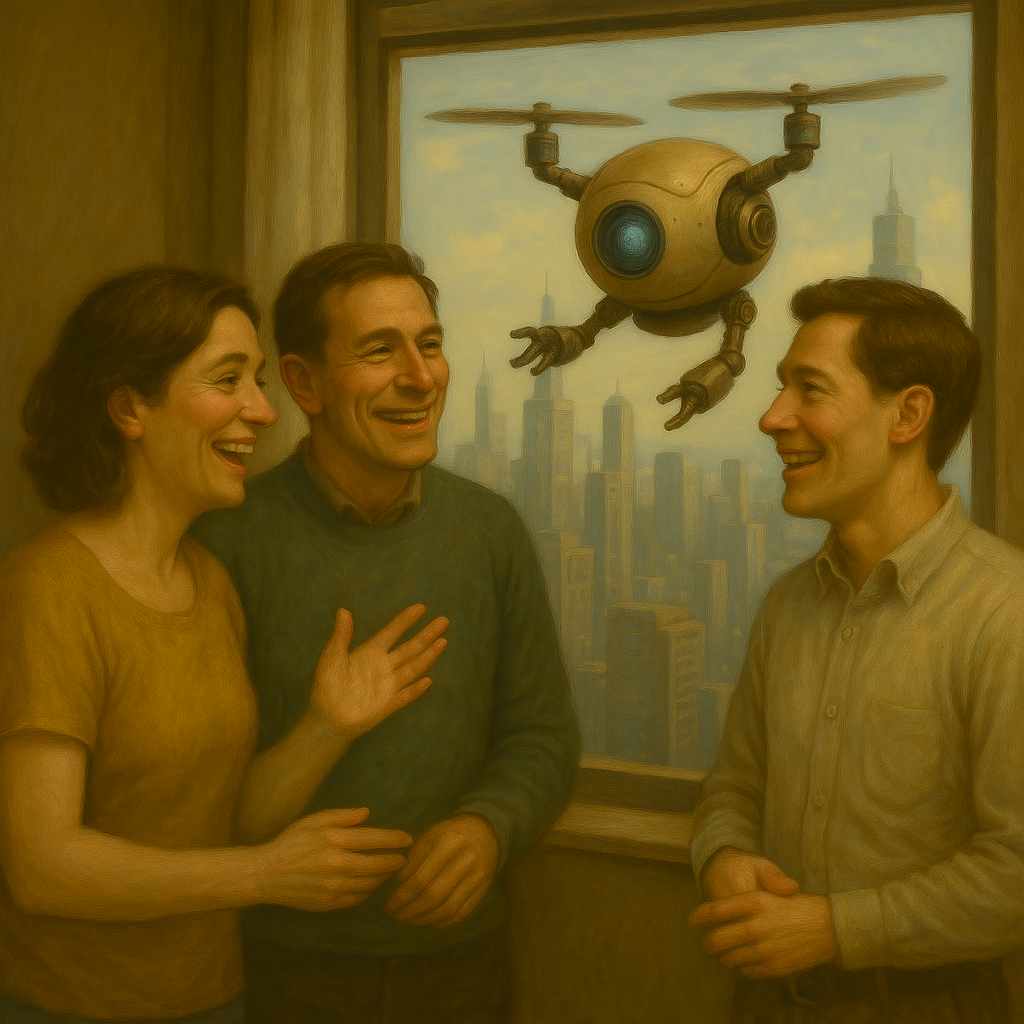
Linas Beliūnas published a news story about a Chinese man who wears glasses to study how humans work and uses this data to train robots to perform the same tasks.
— — — — — — — -Questions — — — — — — — — –
How good or how bad is this?
Here are some answers, time permitting.
Well, is this ethical?
Is this useful?
Would it result in job losses?
What replacements for jobs would be there?
What would humans do then?
Should everyone use these Chinese datasets, or should one create their data for their robot?
Should every product come with training data to teach a robot how to use it? For example, a robot to correct issues in a XYZ brand of car and another to train on an ABC brand of cars.
Is this data product dependent?
Do we need to wear new training glasses for each product to train a robot?
— — — — — — — — -Answers — — — — — — — —
So many questions. Below are some possible answers.
Training glasses to train robots to replace humans? Honestly, it can never fully happen, but yes, robots can take over many types of jobs.
I have heard that in many countries, people don’t work excessively, but in China, South Korea, and many other nations, there is a culture of working excessively to compete and enhance life.
So if we make robots learn to operate coffee machines, pick cauliflowers from farms, or harvest wine grapes, what’s wrong with it if you don’t like to work much, especially if you’re someone who works hard and parties harder?
So, buy a pair of robot training glasses and teach them to pick up wine grapes. What are your thoughts on this? It’s not happening tomorrow; it may take 5 years to get such a robot if you want it. If there is demand, then only there would be supply.
But create your data, don’t buy Chinese data.
Buy a pair of glasses to cultivate your farms? Train your robot? What do you say? You already spend money on hiring staff.
It’s not ethical until all details are provided.
People should be fairly paid.
Which people need to be compensated? I will cover this in a separate article. Let’s focus on training robots today.
— — — — — — — — — — — —
In China people work really long. No one can work like this for long. I am not suggesting that jobs be replaced. We need to achieve a work-life balance alongside rapid development and improvements in living standards.
They can sell this data for massive amounts that Americans would love to buy. Remember when tariff news came out, China sent videos showing sad Americans in chip-making factories. So China thinks Americans need this data. Even Chinese people would feel relieved working 8 hours a day, as long as China promises its workers a lifelong payout from the profits after this mechanism. For tough jobs, this could be beneficial — tasks such as mining, space exploration, chip manufacturing, fabrication, button sewing, milk production, and many other trades where workers are consistently in demand.
This robotic learning should be limited to non-human-friendly jobs.
People can simulate these jobs to obtain data if they prefer not to purchase data from Chinese companies. Every product needs different specifications, so different rules must be followed by robots. So, wear your glasses to teach your robot how to use your Mac? Why do you need someone else’s data? It would increase computational errors.
Chinese workers should receive compensation for job loss resulting from the automation of this kind.
What would people do? Guiding and maintaining robots, living with new jobs and work-life balance — when automation first arrived with computers, people moved to other sectors.
New types of jobs that never existed before were created. So, wait for new job sectors.
References
PhotoCredits: AI
 Artificial Intelligence, Computer Science & Mathematics