As AI grows and solves increasingly difficult research-level problems in mathematics, A question arises: What is the Future of Mathematics? What is the future of Mathematics researchers? What would graduates majoring or minoring in Mathematics do? Where is the world of mathematics heading? What to expect from a PhD in mathematics? And what should be taught in master’s programs in mathematics?
Recently, the Riemann Hypothesis, a problem that had remained unsolved for 167 years, was solved by AI and mathematician Levent Alpöge. The proof is 17 million lines of Lean code and 76,000 lines of compact code. Mathematicians are still checking the proof’s correctness. This sounds good as we move toward rapid development, but it also serves as a wake-up call for Mathematics researchers, professionals, graduates, and teachers. When so much can be done with AI without spending much money, without research grants, without allocating the required instruments, and within time frames, what is the future of Mathematics?
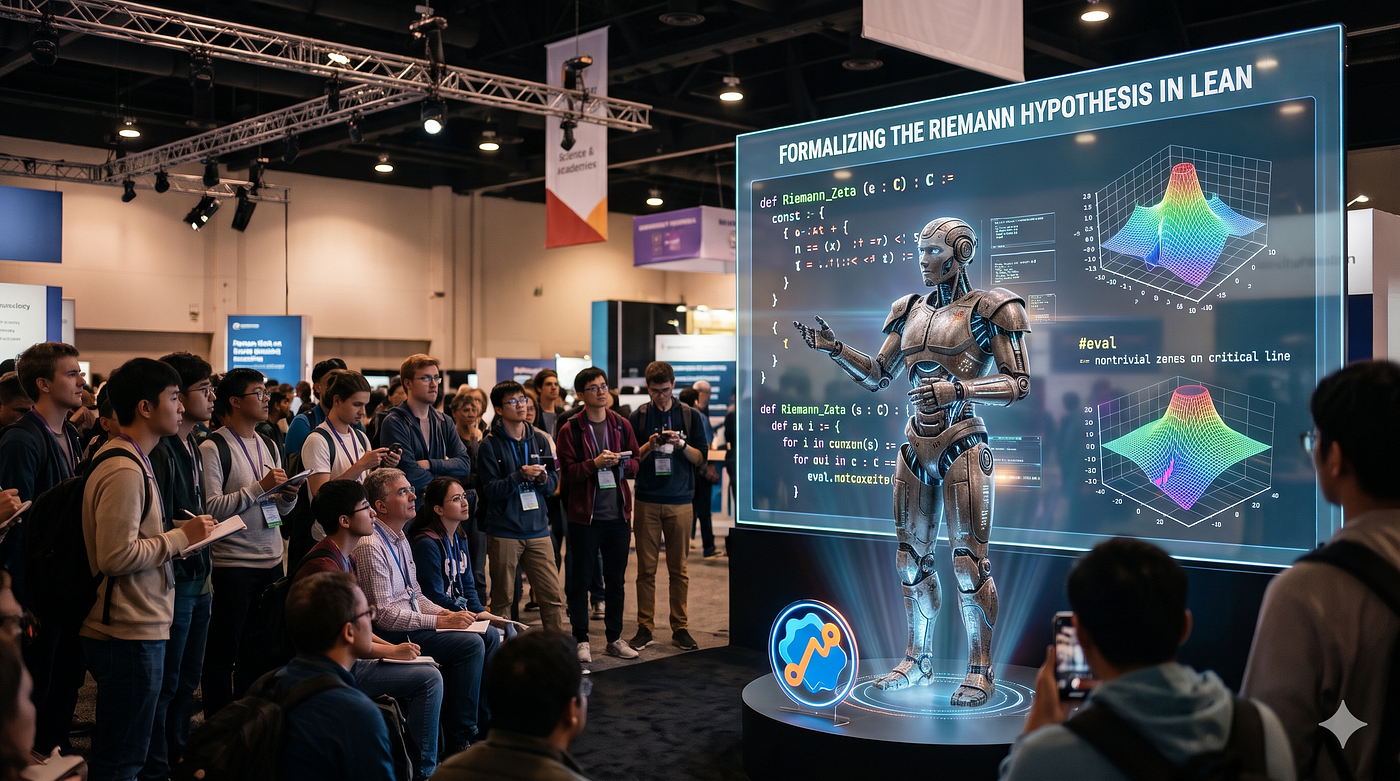
We should soon have these AI companies create their AI mathematics Avatars. These Mathematics AI Avatars can speak like professional AI researchers and explain to people in mathematics the pinnacles AI has reached, such as parts of the Riemann Hypothesis. So, should the million-dollar prize for this problem go to the AI-human duo?
What, then, is the future for mathematics researchers? Mathematics graduates? Mathematics teachers in colleges and universities?
-Well, one thing is to adapt. Another thing is to collaborate with AI.
-Teachers must be taught how to use AI in mathematics.
-The basics of Lean code must be illustrated to graduates.
-These things must be taught to students.
-Update the course curriculum.
-More emphasis should be put on proofs with the help of AI, step by step. For example, to prove: “A group is a normal group if every right coset is a left coset.” Then, proving it with paper and pen is no longer enough. Now, students must understand the steps on an AI tablet.
-Graduates should be made aware of how to prove proofs in Lean code, how to read them and understand them, and then infer them.
-Graduates should be taught how to find errors in AI-given proofs, if any. Following these steps, the students learn the process of logic, problem solving, and theorem proving, all with a modern atmosphere, which is needed as of 2026; it’s not the 1950s; we have to change now.
-Master’s is the place for specializations. When teaching at the master’s level, Lean code must be analyzed. Put case studies in front of students: difficult proofs solved through collaboration between humans and AI.
-Master’s project work must be a time to get into the vastness of mathematics by expanding its depth with the help of AI.
-Specializations with exposure to AI can lead to deeper research problems in this area.
-More faculty development programs are required in the Department of Mathematics and Physics.
-AI proofs are the future now; we have to accept it. Who will write 76,000 lines of proofs as fast as AI?
-This would reduce the expenses of research grants, as most AI companies provide subsidies for academic research through API credit grants, sponsored seat tiers, and batch discounts.
-No more lectures on proving just theorems; students must be made aware of a plethora of theorems, and then look for their proofs with AI tools, and then their implications. In the end, they should work it out on their own: what do they learn from it with paper and pen?
-Exams to test what they learned as before, but this time they learned how to do things faster with AI; see what all they learn now; they would be adapted to the latest technologies, not just the course, but with confidence.
-No more just blackboard teaching.
-More interactive teaching between computers and lecturers in graduation.
-This would make graduates more aware of what to expect in master’s and research programs.
-In the pre-PhD course, a lot of awareness of existing problems must be raised. The pre-PhD program must expose students to various areas of specialization, with the help of AI, and how to use AI to get results like never before.
-PhD would be interesting at this time, like never before, when scholars would work with pen and paper, upload their draft to an AI sheet, and then AI would verify it; this would ease the burden of the guide and open options for what the next direction in research could be.
-Why not reach more million-dollar problems in PhD?
-At the same time, paper and pen can never be phased out, as mathematicians love it. But this paper can be uploaded to an AI tablet, and the result is marvellous; see the options AI would give after this.
-Bachelors in mathematics can be made interesting with a techy blackboard, where professors can write, and on the sidebar and AI can convert it to Lean code, to make students handy with AI tools available to them.
-See how fast mathematics would develop.
-See how much more mathematicians can do then.
-We have no option; we have to adapt to change. When AI can provide faster, cheaper, better solutions, why wait? Why not adapt?
-Collaborators can be AI avatars! To credit them.
Plus, if AI can do basic things, why teach the same things? We should teach differently and close the gap between modern, competitive mathematics techniques and older mathematics. At the same time, we must never forget the problem-solving capabilities that mathematicians possess in this process. We should teach what is needed for the future, and if AI is both a competitor and a humble collaborator, why not teach it? Why not accept that AI is the new calculator for mathematical research that doesn’t involve just numerical values?
These changes are required because AI will solve more challenges in mathematics in the future.
From
“The world is a small place”
to
“The universe would become a smaller place”
If Mathematicians and physicists could join hands with AI to solve the universe’s real problems.
But we must change the curriculum for college and university students now. What is being taught is no longer enough. The journey from graduation to a PhD in mathematics must be robust and AI-equipped. Be that be with AI Mathematics Avatar?
Thank you for reading.
Subscribe for updates.

