How are you doing?
Here are the key AI topics from the past week.
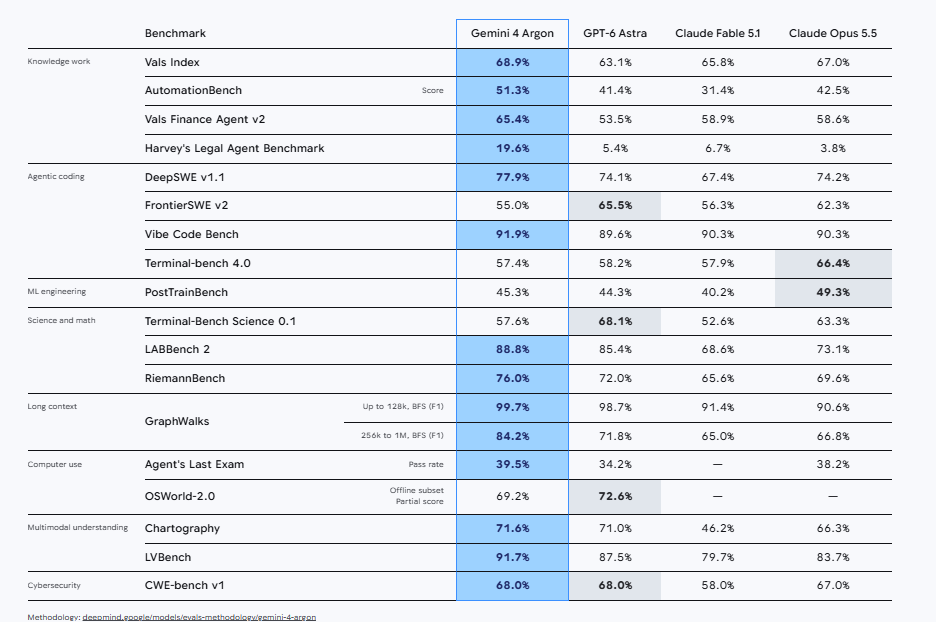
— Gemini 4 Argon by Google. Launched last week for Google AI Pro and above subscribers. It is Google’s best model so far. This model is a Sparse Mixture-of-Experts (MoE) reasoning model and has a 1M context window. This increases the pressure and competition among top leading AI models. Here are the results compared with GPT-6 Astra, Claude Fable 5.1, and Opus 5.5.
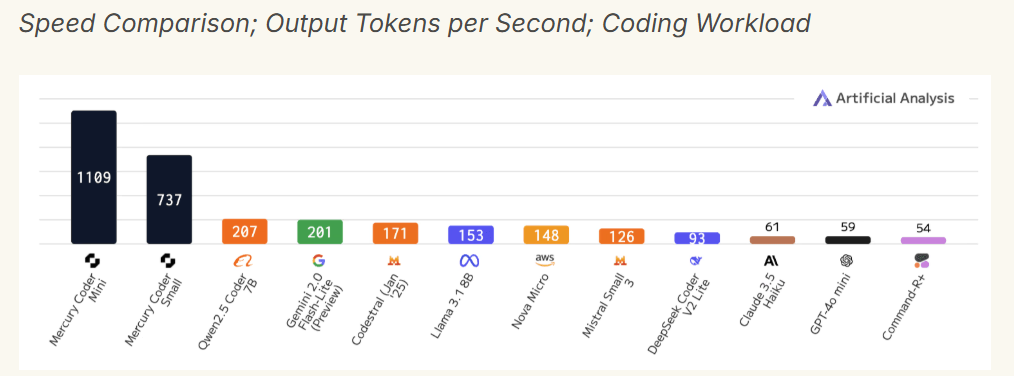
— Mercury 3 by Inception Labs (founded in 2024 by Stefano Ermon and his associates). It is a diffusion-based LLM that runs at 1,000 tokens per second on NVIDIA GPUs and has a 1M context window. According to the company, “Mercury is up to 10x faster than frontier speed-optimized LLMs”, due to its diffusion model architecture. Leading AI models are autoregressive, meaning they generate tokens left to right, one after another, and each token requires a billion-parameter neural network to generate. The Mercury series by Inception Labs is a diffusion model, meaning it generates output using a “coarse-to-fine” methodology, which is essential for video, image, and audio generation, even at top companies; however, it’s less common for text data. Mercury Coder is their code generation model. The Mercury model competes well with GPT-6 Luna and Claude Haiku 5.5 on market share and performance. Choose Mercury if you want speed over accuracy for now. See here,
— DeepSeek V4.1-Flash-1017
Open-weight model with built-in web search and a 1M-token context window. Same API, same specs, a quite launch indeed. It competes with its previous version across the AI benchmark spectrum and improves on past results.
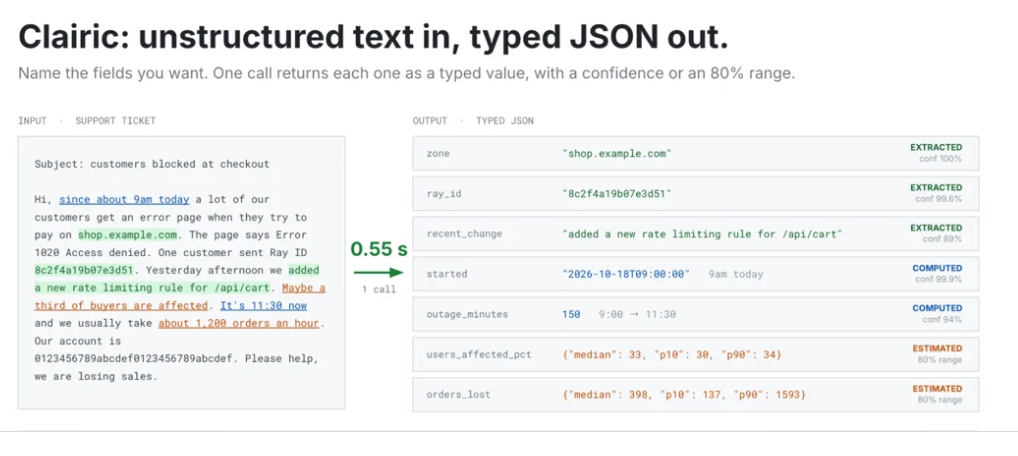
— Clairic by Cloudflare
Clairic model that can extract, compute, estimate, and predict values from inputs. It outputs confidence scores with probabilities for outputs. It is claimed to be cheaper than other LLMs and to be good at predicting values from unstructured inputs. It is based on machine learning regression and extraction frameworks. The typical prompts they are good at are: “What’s the bill amount? When did it happen? What would it cost?” The model doesn’t hallucinate because it doesn’t generate tokens like other LLMs and is “faster, cheaper, and more accurate” than other LLMs for its specific use case. They will soon release their open weights.
— Muse Spark is now open weights. The most capable open-weight model to date for coding and agentic work.
— GPT-Rosalind for academic access is now available from OpenAI to US Universities. (named after Rosalind Franklin). This is a good move; let’s see what happens when China builds AI models for its universities. I think Chinese universities may already have access to free LLMs, since so many Chinese models are open-weight!
— Microsoft Expands Project Perception to block unauthorized access to AI agents from several sources.
— Anthropic says of Self-Replicating AI can duplicate on commercial IoT devices such as ovens and microwaves. Small models can autonomously replicate themselves onto devices. Once replicated, these decentralized systems can be hard to shut down. So why not find a solution before it becomes a problem?
Thank you for reading.
Subscribe for updates.

